Blog, news and resources | Woolton Tutors

How to answer A-level biology application questions

A lot of our tutees ask how to answer A-level biology application questions. Application questions (AKA “applied knowledge” questions or assessment objective 2, AO2 questions) challenge you to apply your knowledge in an unfamiliar setting. Essentially, they are biological puzzles, and you have all the information you need to solve them – the real challenge is working out how and where to start.

Here are a few tips to guide you through:

  1. Ask yourself – what topic is this?

Look for key words and phrases that give you clues to which topic area (or areas) the question relates to. There may be a lot of information in the opening part of the question here that you’ve not seen before – that’s ok! It’s designed that way. If there’s a strangely named chemical described as an enzyme, everything you know about enzymes and proteins might be useful. Do we have an unfamiliar gene? Great – now everything you know about transcription, translation, epigenetics and even genetic engineering could be relevant.

It’s best to start with a clear idea of the context of the question.

Continue reading “How to answer A-level biology application questions”

How to answer A-level biology evaluate questions

One of the most popular requests from online A-level Biology students is “How do I answer A-level biology evaluate questions?” (AKA assessment objective 3 (AO3) questions)

Usually, these questions involve scientific data and a conclusion made by a student, journalist or politician. The idea is to discuss their conclusions and decide how much you agree.

Here are a few tips to try:

1. Don’t be afraid to agree AND disagree

Evaluate questions are usually looking for a balance of your opinions. You probably won’t agree completely, or disagree completely with a conclusion and that’s fine. The good news is there are marks for providing evidence for and against.

2. Look for “sweeping” statements

Usually “evaluate” questions are testing your ability to spot where the “story” in the science has been misinterpreted. Often the conclusion over-reaches – maybe it says a drug “cures lung disease” when the data only shows an effect on cells in dish, or in rabbits rather than humans. Look for places where the conclusion and the data are mismatched. Continue reading “How to answer A-level biology evaluate questions”

Five common PhD viva questions (and how to answer them)

I thought my viva would be a walk in the park. I’d proofread my thesis so many times – given chapters to unfortunate colleagues, polished the thing until it gleamed. Surely the viva was just a formality? What PhD viva questions could they possibly ask? Then I opened the door and saw my examiners, glasses perched on noses, with the copies of my thesis bristling around the edges with post-it notes.

Your PhD viva voce or defence is the culmination of a lot of hard work. Years of trial and improvement, highs and lows, dead ends, changes in direction. It’s a story of you and your choices as much as it is a piece of research. You owe it to yourself to be prepared. One final hurdle. Then you can write “Dr” on your Tesco Clubcard. (And if you’d like some one-to-one help preparing for your viva, please see here.)

During your viva, your examiners are trying to establish three things –

  • That you did the work (and wrote the thesis) yourself.
  • That you can defend (and argue) your choices and conclusions.
  • That you are (trying to be) free from bias.

A viva is like a job interview… after you’ve done the job. The overriding question is “is this person worthy of joining academia”?

Here are five PhD viva questions your examiners will ask, and how to answer them:

1. Why did you decide to do *this part of your research* in this way? Continue reading “Five common PhD viva questions (and how to answer them)”

A-level biology grade boundaries 2026 and exam dates

It’s often difficult to find the A-level biology grade boundaries and exam dates all in one place, so I hope this is helpful. 🙂

Grade boundaries for the 2026 A-level biology exams

AQA A-level biology grade boundaries:
Based on 2024 AQA A-level biology results
A* 74% (192/260 marks), 63%  A (165/260), 54% B (140/260), 44% C (115/260) (scores rounded to nearest mark)
2023 grade boundaries
A* 69% (180/260 marks), 59%  A (153/260), 48% B (125/260), 38% C (98/260)

Edexcel (Salters Nuffield) A-level biology grade boundaries:
Based on 2024 Edexcel A-level biology results
A* 66% (199/300 marks), 57%  A (171/300), 48% B (144/300), 39% C (117/300) (scores rounded to nearest mark)
2023 results
A* 74% (222/300 marks), 64%  A (192/300), 54% B (162/300), 44% C (132/300)

OCR A-level biology grade boundaries:
Based on 2024 OCR A-level biology results
A* 68% (187/270 marks), 57%  A (160/270), 48% B (136/270), 39% C (112/270) (scores rounded to nearest mark)
2023 results
A* 68% (183/270 marks), 57%  A (155/270), 48% B (130/270), 39% C (106/270)

Exam dates for the 2026 A-level biology exams

AQA A-level biology (based on this page)
Paper 1 – 4th June pm (2 hours)
Paper 2 – 12th June am (2 hours)
Paper 3 – 16th June am (2 hours)

Edexcel Biology A (Salters Nuffield) (Based on this page)
Paper 1 – 4th June pm (2 hours)
Paper 2 – 12th June am (2 hours)
Paper 3 – 16th June am (2 hours)

OCR A (Based on this page)
Paper 1 – 4th June pm (2 hours 15 min)
Paper 2 – 12th June am (2 hours 15 min)
Paper 3 – 16th June am (1 hour 30 min)

Good luck! Hope these help 🙂

Best wishes,

John

Dr John Ankers

Specialist online A-level biology tutor and academic wellbeing coach

https://wooltontutors.co.uk

How to avoid losing marks in A-level biology exams

Matching the mark schemes in A-level biology can be frustrating. Often students say “I just don’t know what the question is asking for”, or “I keep missing out on full marks”. Here are some tips on how to avoid losing marks in A-level biology exams and focussing on your exam technique.

Go further with the question’s command word

When answering a question, notice the number of marks available – these are the number of points you should make in your answer. If you’re missing something, focus on the command word – describe, explain etc. – and let yourself go into more detail. It’s a “describe” question? Describe in more depth what the graph shows. For an explain question, go further into the explanation of the science. The key is to see what the question wants and dive deeper into the detail.

Nothing is “too obvious”

Students often say “I didn’t write that because I thought it would be too obvious”. Say the obvious thing! Students, often the brightest ones, often miss the first or last marks in a mark scheme answer because they think the examiner already knows this information. Yet these are the marks where you tie your answer to the question. Always complete your thoughts even if it’s as simple as saying “so photosynthesis increases” or “so the plant would die.”

Use the correct terminology

Examiners often want to see you use the correct A-level terminology – this means “hydrolyse” instead of “break down”. Energy is “transferred” not made. When a substance moves, does it actually “diffuse”? Maybe it’s “actively transported”.  Complementary is a great word – you can use it whenever two shapes are matched – enzymes and substrates, antibodies and antigens, complimentary nucleotides…

Avoid using “it” in your answers – either say the name of the protein, chemical or species you mean or use another noun to help free up your writing – perhaps – process, relationship, variable, data (plural) or “piece of data”.

Spot your patterns

Analyse your last mock exam paper – are you missing marks from an entire question? This might suggest an area of knowledge needs improving. Or are you missing single marks that mount up? Rather than lack of knowledge, this suggests you may not be completing your answers, or missing terminology. It might be that some of the tips above will help. The key is to communicate clearly.

Perhaps a one-to-one tutoring session with me leading up to the exams might give you a boost?

You can also take a look at some of my other blogs on evaluate questions, describe and explain questions and application questions.

Good luck!

There’s much more help with exam questions in our eBooks available in our shop. We also offer annotated model answers to A-level biology papers.


If you’d like to work through some A-level biology statistics questions, from exam boards like AQA, please get in touch with me at Woolton Tutors, and we can set up some online A-level biology tutoring sessions. Alternatively, AQA students might be interested in my weekly A-level biology masterclass sessions for practice on exam technique.

Best wishes,

John

Dr John Ankers

Specialist online A-level biology tutor and academic wellbeing coach

https://wooltontutors.co.uk

How to deal with maths anxiety

Maths anxiety is very common. I’ve worked with people of all ages who want to improve their maths but struggle with the idea. Sometimes emotions get in the way. Perhaps you need to pass a qualification at work? Or want to handle your finances better? Maybe you’re facing your maths anxiety “gremlins” following a bad experience at school. These can be brave choices.

Here are a few tips and ideas to help you feel better about maths:

Focus on what you need from maths

Maths is a broad subject covering everything from addition and subtraction, to shapes and statistics. Although school qualifications tend to offer a taste of all of this – if you’re returning to maths after a while away you might not need to deal with every aspect of maths. Instead, decide on what you DO need. Perhaps you want to be able to perform drug calculations for a nursing qualification? Or engineering equations? Do you simply need to refresh your knowledge for handling your accounts?

Make a list of exactly what you want from the subject. What can maths do for you? Put yourself in control.

Demystify the maths

Maths can feel impenetrable, like an ancient language, but we can soften the subject be looking calmly at what it actually is. It’s true: mathematics is a language – a language of numbers, letters and symbols that we can use to describe the world and its rules. Maths is supposed to help – to aid communication rather than act as a barrier.  Sometimes mathematicians forget this. Mathematical equations are just statements about relationships between things. These “things” are often represented by letters (this is algebra) and the story of their relationship traced by a line (on a graph). One of my first aims when tutoring students with maths anxiety is to take the sting out of it. (See below for more about our tutoring services.)

Banish the maths gremlins

Many of my adult maths students are returning to the subject after a number of years having pushed maths away. They say things like “I was never good at maths”, or “I can’t do maths” or even “I dreaded maths at school”. Sometimes they are angry, sometimes there are surprised by tears. Returning to the subject if often about more than crunching numbers, it’s actually a way to heal from a bad experience in the past. Facing these complicated feelings is incredibly brave. I am a qualified coach as well as a professional tutor. Helping people with maths anxiety draws on all these skills. With experience I will say: you can face maths gremlins from the past, and you can fill any gaps they left – and yes, you can absolutely have a smile on your face while you do it 😊

Practice your maths skills

Part of strategy for becoming comfortable with maths is practice. Firstly, because like any fear – facing it brings confidence. Sometimes you’ve just got to do it! Once you’re comfortable approaching maths, on whatever level you choose,  practice helps you keep your skills sharp. Like learning a language, practice little and often is the best way to ensure you get the most out of these skills. I’m happy to recommend books, apps, or websites like National numeracy.

Get help with your maths

If you decide you need some help with your maths you might consider a private tutor. I’ve been tutoring maths for over 10 years, and have a PhD in biology and mathematics. I’ve worked with many students from GCSE up to adult learners. My advice is to find a tutor who is right for you – who puts the concepts across in a way you understand. If you want some advice on the best way forward for you, please get in touch.

Best of luck with your maths,

John.

Dr John Ankers

Specialist online science and maths tutor
John@wooltontutors.co.uk
https://wooltontutors.co.uk


How to choose statistical tests in A-level biology

Statistical tests are tools scientists use to spot important relationships – those rising above the randomness or “noise” in the universe. We use statistical tests in A-level biology because even if a change or difference in our data “looks” dramatic by eye, the test provides the unbiased reassurance to make our conclusions confidently.

Statistical tests work by setting a threshold (called the probability value level, p-value level or confidence level) used to separate important changes from differences that could be explained by randomness in our measurements. Only differences rising above this threshold gain the title “significant”. (I’ve written a separate blog on how to use the p-value in A-level biology).

Importantly, it’s the relationships between our data that are tested, not the data itself.  So, we might use statistical tests to compare two sets of data and find them “significantly different” or “significantly correlated”.

But how do we know which statistical test to use?

Choosing statistical tests in A-level biology

Firstly, some good news – you don’t need to memorize any mathematical formulae! If you need them in the exam, they will be given to you. But you do need to know how and when use the tests. (And if you are with the OCR or Edexcel exam boards you may have to actually do some calculations.)

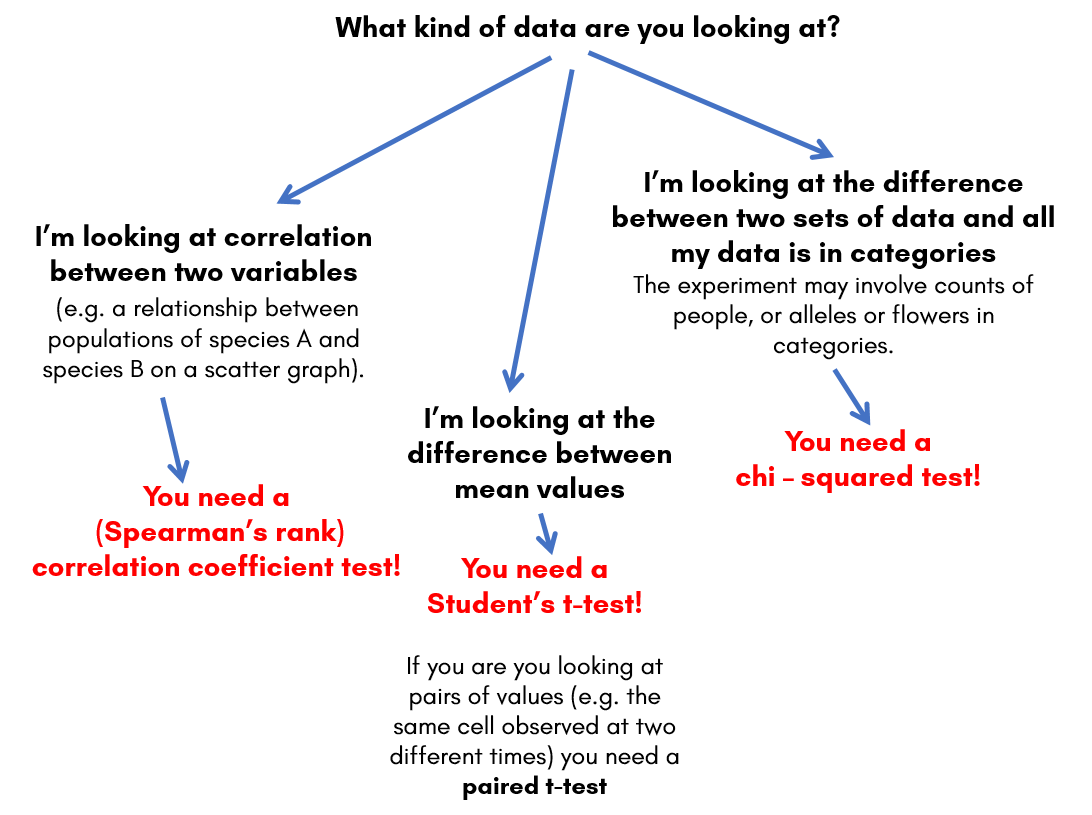
Which statistical test we use depends on which one best suits your data. We have a choice of three different statistical tests in A-level biology:

Chi-squared test – used when looking at differences between frequencies (data that is counted) in different categories (known as discrete data).

Student’s t-test – used to look at differences between means (averages) of data involving measurements (like lengths, or times).

Spearman’s rank correlation coefficient test– used to look at the correlation between two variables in measured data.

Here is a diagram to help you choose:

statistical tests in A-level biology

Examples of choosing statistical tests in A-level biology exam questions

Exam questions may present you with a situation – perhaps a scientist doing an experiment – and ask you to choose the appropriate statistical test. Here are some model answers to real A-level biology exam questions involving a
choice of test:

(While I cannot reproduce the questions here for copyright reasons, I have linked to the actual papers on the exam board websites.)

AQA 2022 paper 2 Q 6.5
This would require a Chi-squared test (as the data involves frequencies in categories).

AQA 2019 AS paper 2 Q8.4
This would require a t-test (this is tricky as the data presented involves frequencies, but the statistical test would be aimed at the difference between mean values – which are measurements, so it’s a t-test we need).

OCR 2022 biological processes paper Q9
We would choose B: The (unpaired) t-test. Unpaired because the data from light and dark are not related (i.e. they are not the same cells analysed different times) and a t-test because we would pool the data from cells in light vs dark areas to examine the difference between mean values.

Hopefully this helps with you choose between statistical tests in A-level biology exam questions! This blog is part of a larger study guide to A-level biology statistics (see below). I’ve also written about how to answer A-level biology evaluate questions, and application questions, but what about “Describe” and “explain” questions.

Good luck!

How to use statistical tests in A-level biologyThere’s much more help with statistical tests, p-values, significance etc. (and model answers to statistics exam questions) in our eBook “How to use statistical tests in A-level biology”, available here.  We also offer annotated model answers to A-level biology papers.

If you’d like to work through some A-level biology statistics questions, from exam boards like AQA, please get in touch with me at Woolton Tutors, and we can set up some online A-level biology tutoring sessions. Alternatively, AQA students might be interested in my weekly A-level biology masterclass sessions for practice on exam technique.

Best wishes,

John

Dr John Ankers

Specialist online A-level biology tutor and academic wellbeing coach

https://wooltontutors.co.uk

How to improve your critical thinking skills

Critical thinking is about finding a message in the noise – examining information from different sources to reach fair, unbiased conclusions. Developing your critical thinking skills is often crucial to “thinking like a scientist”. But evaluating data from multiple sources is also an essential part of modern life. With so much debate over “fake” news, misinformation and disinformation, and AI-related manipulation, critical thinking skills can help you determine who to trust and why.

Critical thinking skills are also an important part of education, from “evaluate” questions in science, to the A-level EPQ, up to postgraduate and academic reports and assignments (which I can help with). The British Government are planning to make critical thinking an even bigger part of primary and secondary education, but critical thinking is a life skill whatever your politics. It’s about learning how to think – so you have the freedom to decide what you think.

Here are some tips for developing your critical thinking skills:

Learn to separate fact from opinion

Whether it’s a statement in a newspaper, a web site or social media – your first job is to establish if the basis is fact (did it really happen? Is there any proof? – see sources below) or opinion (someone is presenting their own conclusion, which may be subject to bias – see below). Both are useful to your balanced view, but should be handled very differently. You could suggest, for example, that two people have interpreted an event differently, with all their experiences and potential biases called into play, so long as you make the line between fact and opinion clear.

Who or what do you trust? The importance of sources

In building your view of a topic, it is important that any information you rely on is trustworthy. The sources you use should/will always be transparent and public (so they can be checked, just as you are checking on other people’s sources). But how do you decide what to trust? Eyewitness observations, videos or (experimental) data are the safest form of establishing trust – although these (and the trust they carry) are not immune to manipulation. When gathering academic sources, look for work published in established peer-reviewed journals, or papers that have been cited multiple times by other researchers.

Question everything – Look at the core data when evaluating a source

If you are writing an academic report (your assignment may be to “critically review relevant literature” or “critically evaluate the scientific basis”), the temptation may be to include a source based solely on its “headline” – the core hypothesis or message. Where possible, make sure you are comfortable that the data supporting these sources, and how they are analysed, backs up these “take home messages”. A-level students use this approach in their “evaluate” questions, or during their Extended Project Qualification (EPQ).

Bias, motives and balance

Considering different points of view is essential when presenting the balanced view that we’re striving for with critical thinking. A core argument may have sources in support and in disagreement – this is natural and healthy, and helps you to discuss the current thinking around topics that may be controversial.

Real life is rarely black and white though (see language below). Calm, balanced appraisal of the complexities of a situation, with empathy, is often how people reach a point of understanding. Generally, points of view that seek to inflame, “gas light” or otherwise encourage division are to be treated with suspicion – still discussed, of course, but with a cautious eye on motives and bias. Bias is also an important consideration in self-reflection – how did your opinions change throughout a project? What did you do as a result?

Language is important – theirs and yours!

When evaluating a source, look for sweeping statements – does the data really apply in “all” cases? Is “every” person the same? Generally, good research favours open language, allowing for the possibility of exceptions to rules. During critical analysis, make sure your conclusions are open too – “all” becomes “most” or “many”, while “every” is diluted to “frequently” or “often”.

Why trust me?

I’m a former scientist with a PhD in cell biology and mathematics, now a tutor and coach. I’ve written for the Royal Statistical Society on shaky statistics in the media, and have over a decade’s experience as a freelance science writer. I’m hoping you might like some one-to-one help developing your critical thinking skills (That’s my bias!)

Generally, though, the point I’m trying to make is don’t give your trust out lightly, develop your critical thinking skills and decide for yourself.

Good luck,

John
Woolton Tutors

Dr John Ankers is a specialist tutor, mentor in critical thinking and academic coach.

Studying A-level biology in Dubai – what are the options?

Many UK expat families are relocating to the United Arab Emirates with teenage children. Parents and students often ask me what the options are for studying A-levels in Dubai. Here are some details about the next steps and the choices you have. We’re focussing on A-level biology in Dubai, but many of these points apply more generally too.

Choosing a school in Dubai vs online school vs home school (home education)

Enrolling at a local school to study A-level biology in Dubai

Depending on your circumstances, one of the local schools may be a good option. Enrolling for A-level biology at a Dubai school gives you two years’ teaching on topics like genetics, homeostasis and photosynthesis, together with practical skills and experience (more on this below). Exams are usually taken at the school (most schools double as exam centres). Each school will have its own requirements for entry in terms of grades at GCSE or equivalent and may offer A-level biology courses from different course providers (see below).

Here are some popular Dubai schools, with the specific A-level biology courses they provide:

GEMS Jumeirah college 19th St – Al Safa
(Biology course/exam board: Edexcel Salters Nuffield)

Dubai College Al Sufouh – Al Sufouh 2
(Biology course/exam board: Edexcel Salters Nuffield)

Dubai British School Emirates Hills Town Centre – Springs 3 Emirates Hills
(Biology course/exam board: Edexcel Biology B)

Dubai English speaking school and college Oud Metha Rd – Umm Hurair 2
(Biology course/exam board: AQA)

Safa community school Sheikh Mohammed Bin Zayed Road
(Biology course/exam board: AQA International A-level)

GEMS Cambridge International school Al Twar 1
(Biology course/exam board: Cambridge International A Level)

Differences between the A-level biology courses are discussed below.

Enrolling for A-level biology at an online school

Online schools provide an alternative for A-level biology students who need to move around (perhaps through family commitments) or who prefer online learning from their own home. Again, these schools have individual requirements (and fees) and offer different A-level biology courses.
Studying A-level biology at an online school still requires you to attend an exam centre to sit exams (although online exams are currently being trialled by the AQA). You may also need to attend a local centre to gain a “practical endorsement” required by some universities (see below).

Home-schooling (home education)

Some A-level students opt for an entirely home-schooled (home educated) approach. Here you have lots of flexibility in choice of A-level biology course provider/ exam board, but more admin to take care of. You’ll need to register with the British Council at least six weeks before your exams and find a local exam centre offering A-level biology in Dubai. The exam dates can be found on the website of your course provider, for example AQA, Edexcel. You’ll also need to decide if you need to earn your “practical endorsement” (see below).

Private tuition can complement all of these approaches – working with a dedicated one-to-one tutor throughout your course. I am a specialist A-level biology tutor if you want to get in touch for any advice on your options 🙂

Choice of exam board for A-level Biology in Dubai

Studying A-level biology in Dubai Different schools offer A-level biology courses from different exam boards. OxfordAQA, Edexcel, and Cambridge International Education (CIE) offer “international” A-level Biology courses. These are very similar to A-levels sat in UK schools, with some details changed to put exam questions in a more international context. These international courses are modular, meaning rather than sitting all the exams at the end of the course, assessment is  spread throughout the two years, after each taught module.

The content covered is broadly the same for each exam board including cell biology, evolution, genetics and immunity. Each exam board has a “specification” for their course that can be downloaded from the web sites linked above.

Practical endorsement and applying to university

In the past, assessed practical work contributed to your final A-level biology grade. Now, most A-level biology courses “strongly encourage” you to have practical experience, yet this doesn’t contribute to your final grade. So why do it at all? This separate “practical endorsement” is sometimes known as Common Practical Assessment Criteria, or CPAC.

Your CPAC endorsement is proof that you have practical experience and is sometimes required for admission to university courses like medicine. UCAS checks on your CPAC status during the university application process in the UK. It’s worth checking with your desired university, especially when applying to UK universities from Dubai, to see if the practical endorsement is required. If you are home-schooling, it may still be possible to do your practical training, and get your endorsement, at a local school.

Sharing your experience of A-level biology in Dubai 

Often the best way to find out how schools work (and which is the best for you) is from the inside – to talk to students who actually go there, or have been there.  There is a thriving community of teenagers in UAE on reddit discussing “universities and colleges”. There’s also a discussion on “looking for friends” in Dubai – school is only one side of life in Dubai after all, and balance is important to your wellbeing, and therefore to your grades.

Extra help and advice for studying A-level biology in Dubai

I specialise in online A-level biology tutoring, and have several online students in UAE and extensive experience with home education. If you’d like some advice on your next steps, I’d be very happy to help. Equally if you’d like academic support with your A-level biology, please do get in touch.

Best of luck,

John

Dr John Ankers is a specialist online A-level biology tutor and academic coach.
Woolton Tutors has international clients in UAE, USA and China as well as the UK.


Business German tutoring – language skills in a changing world

We offer online business German tutoring for individuals and teams. Perhaps you are working for a German company? Or collaborating in one of Germany’s many academic or business sectors?

Germany leads in industry areas such as pharmaceuticals, automobiles, engineering and electronics, and  German is the most spoken native language within the EU. Having a functional understanding of “German for business” will help you to collaborate effectively with German partners and clients.

Our flexible online business German tutoring will help you:
  • Improve German language skills whether you are a beginner or sharpening your language skills.
  • Learn practical up-to-date phrases and vocabulary to help you communicate effectively with German partners and clients.
  • Prepare for relocation.
  • Practise German conversation in and around our taught sessions.
  • Strengthen and develop new and existing relationships.
  • Practise conversation around topics you suggest – preparing for a meeting or presentation perhaps (see below).
  • Improve your pronunciation and listening skills.
  • Increase your confidence when speaking German in person on during online meetings.
  • Learn the language in a way that is flexible to your schedule.
  • Get expert help in proof-reading important emails or reports.
Business German tutoring to prepare for a number of situations:business German
  • Important meetings
  • Job interviews
  • Professional development
  • Team building
  • Relocation
  • Advancing your career in a multinational company


Prices start from £50 per hour – please get in touch to discuss your needs.

Sessions are hosted by Sammy Ankers. I am an experienced modern foreign languages teacher, and a former Head of German with a 1st class degree in German.

I look forward to hearing from you.

Sammy

Sammy@wooltontutors.co.uk

Woolton Tutors

Sammy Ankers is a specialist German tutor
Woolton Tutors

Woolton Village, Liverpool, UK and online.