


Whether you’re revising for GCSE or A-levels or preparing for university or college exams, making a revision timetable or a revision plan is an important step to learning anything. Complementing our post on how to revise, here we’re exploring what you need to make a revision timetable, and how to structure your revision sessions.
We find that revision is most effective as part of your weekly routine alongside your learning. In contrast to “cramming” in the days or weeks before exams, (which rarely works and often increases stress) regular revision helps to build confidence.
What you need to make a revision timetable that works:
1. A list of topics you understand
It’s much easier to learn something you understand fully. Make a list of topics you are comfortable with and add to this list as you go. If you need help understanding, consider reaching out to a teacher or tutor. Being comfortable with the information is the crucial first step to effective revision.
2. A place to work
Plan to revise somewhere you feel comfortable and won’t be interrupted. Free of unwanted distraction like siblings, phones or people wandering to the fridge. Unwanted distraction can break your flow, but intentional distraction is a key part of our revision method (see below).
3. A method
Everyone revises differently, but you still need a method to help you exercise your ability to recall the information and test yourself. Our method, using intentional distraction, is supported by educational research, and informed by spaced repetition and active recall.
There’s more on how to use intentional distraction and our revision method in our eBook (see below), but the start of your revision timetable might look like this:
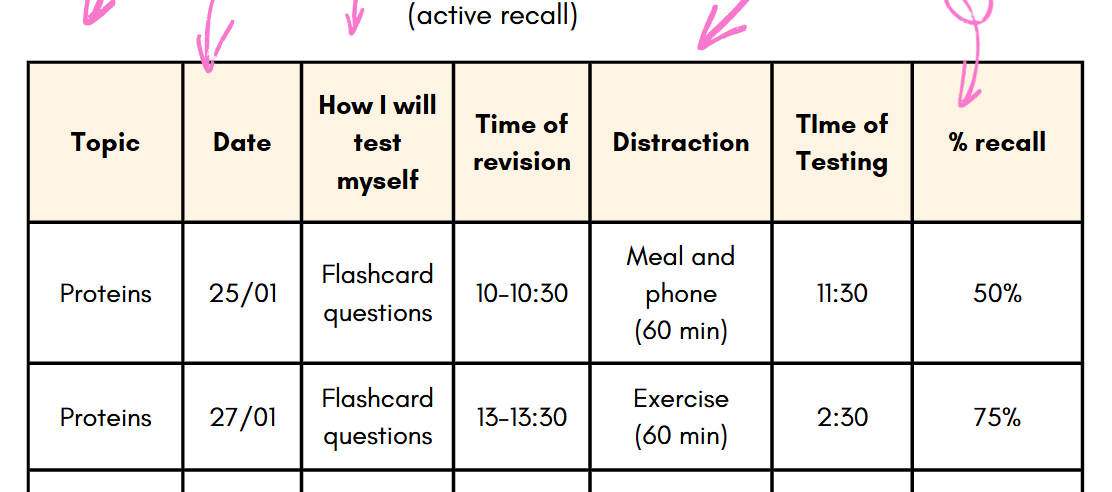
I’ve been using this revision method with my tutees for many years. The results are often quite startling, but it requires commitment. It is very easy to slip back into the feel-good patterns of reading familiar information rather than testing recall.
Remember that the amount of time you’ve spent, or the amount you’ve written out, are not measures of an effective revision session. How much you can recall is.
4. Time
It is up to you when you start revising. We find it’s best to revise as you go, making it part of your weekly routine so class tests, mocks and exams aren’t a shock. The revision method we’re using here allows you to work smarter, not necessarily harder. Gone are the six hour sessions that don’t achieve much. Quality not quantity!
5. Motivation
Revision will only work if you’re committed. You’re training your brain, and like other forms of exercise, revision and recall may take a while to yield results. But they will come. Focus on why you want to revise – what does passing the exam allow you to do, to be?
You can find sample timetables and templates in our accompanying eBook.
Good luck with your revision 😊
 You can find a full step-by-step guide to structuring a revision session, how to use intentional distraction and our revision method, with revision timetable templates (available in .xlsx too) in our shiny eBook “How to make a revision timetable that works“.
If you’d like some tutoring to work alongside your revision sessions, please get in touch with me at Woolton Tutors. If you are interested in working with Woolton Tutors for educational research please get in touch too!
All the best,
John
Dr John Ankers is a specialist online biology tutor and academic wellbeing coach. https://wooltontutors.co.uk
