
How to choose statistical tests in A-level biology

Statistical tests are tools scientists use to spot important relationships – those rising above the randomness or “noise” in the universe. We use statistical tests in A-level biology because even if a change or difference in our data “looks” dramatic by eye, the test provides the unbiased reassurance to make our conclusions confidently.

Statistical tests work by setting a threshold (called the probability value level, p-value level or confidence level) used to separate important changes from differences that could be explained by randomness in our measurements. Only differences rising above this threshold gain the title “significant”. (I’ve written a separate blog on how to use the p-value in A-level biology).

Importantly, it’s the relationships between our data that are tested, not the data itself.  So, we might use statistical tests to compare two sets of data and find them “significantly different” or “significantly correlated”.

But how do we know which statistical test to use?

Choosing statistical tests in A-level biology

Firstly, some good news – you don’t need to memorize any mathematical formulae! If you need them in the exam, they will be given to you. But you do need to know how and when use the tests. (And if you are with the OCR or Edexcel exam boards you may have to actually do some calculations.)

Which statistical test we use depends on which one best suits your data. We have a choice of three different statistical tests in A-level biology:

Chi-squared test – used when looking at differences between frequencies (data that is counted) in different categories (known as discrete data).

Student’s t-test – used to look at differences between means (averages) of data involving measurements (like lengths, or times).

Spearman’s rank correlation coefficient test– used to look at the correlation between two variables in measured data.

Here is a diagram to help you choose:
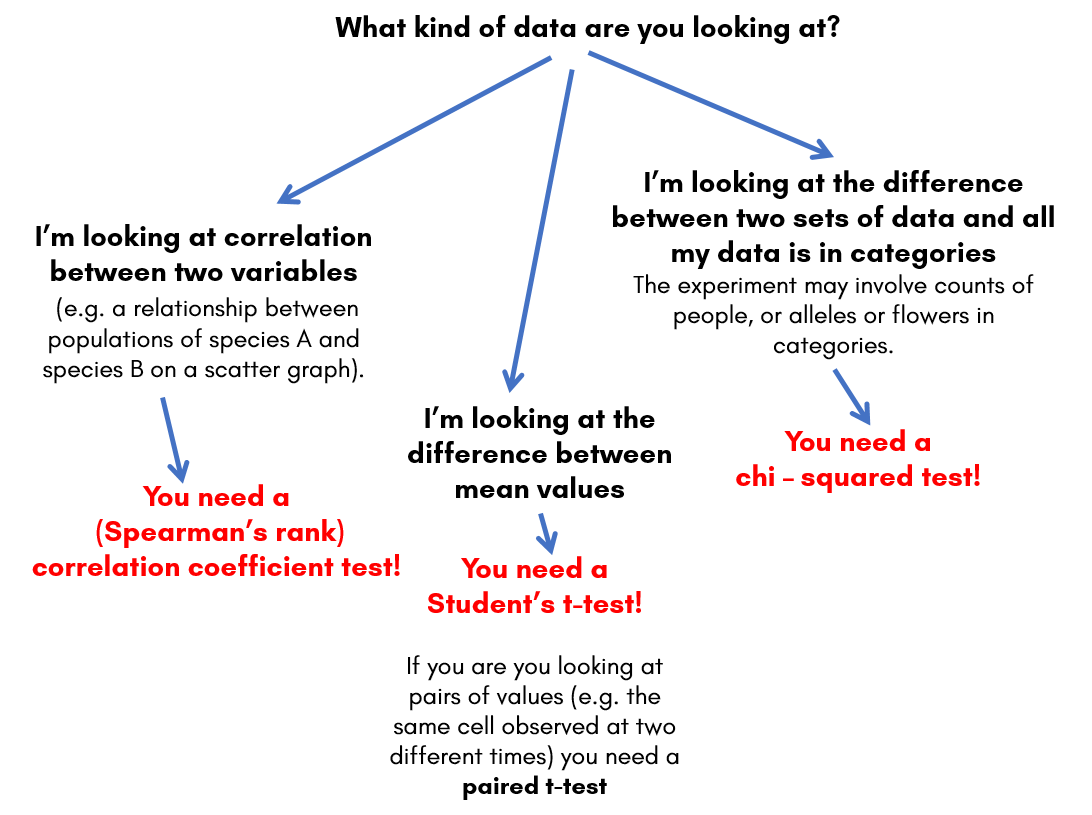
statistical tests in A-level biology

Examples of choosing statistical tests in A-level biology exam questions

Exam questions may present you with a situation – perhaps a scientist doing an experiment – and ask you to choose the appropriate statistical test. Here are some model answers to real A-level biology exam questions involving a
choice of test:

(While I cannot reproduce the questions here for copyright reasons, I have linked to the actual papers on the exam board websites.)

AQA 2022 paper 2 Q 6.5
This would require a Chi-squared test (as the data involves frequencies in categories).

AQA 2019 AS paper 2 Q8.4
This would require a t-test (this is tricky as the data presented involves frequencies, but the statistical test would be aimed at the difference between mean values – which are measurements, so it’s a t-test we need).

OCR 2022 biological processes paper Q9
We would choose B: The (unpaired) t-test. Unpaired because the data from light and dark are not related (i.e. they are not the same cells analysed different times) and a t-test because we would pool the data from cells in light vs dark areas to examine the difference between mean values.

Hopefully this helps with you choose between statistical tests in A-level biology exam questions! This blog is part of a larger study guide to A-level biology statistics (see below). I’ve also written about how to answer A-level biology evaluate questions, and application questions, but what about “Describe” and “explain” questions.

Good luck!
How to use statistical tests in A-level biologyThere’s much more help with statistical tests, p-values, significance etc. (and model answers to statistics exam questions) in our eBook “How to use statistical tests in A-level biology”, available here.  We also offer annotated model answers to A-level biology papers.

If you’d like to work through some A-level biology statistics questions, from exam boards like AQA, please get in touch with me at Woolton Tutors, and we can set up some online A-level biology tutoring sessions. Alternatively, AQA students might be interested in my weekly A-level biology masterclass sessions for practice on exam technique.

Best wishes,

John

Dr John Ankers

Specialist online A-level biology tutor and academic wellbeing coach

https://wooltontutors.co.uk

How to revise for A-level biology (and everything else)

Students often ask for advice on how to revise. Learning is different from understanding, but we need both to get the marks in exams. We can prepare for different questions, like describe and explain, evaluate or application A-level biology questions. But sometimes there is no avoiding it – there is also a lot to learn. So how best to do it?

Alongside our blog on how to make a revision timetable that works, here are a few tips for how to revise effectively. (I’m using “How to revise for A-level biology” as an example here, but all these tips can be applied to other subjects, too): Continue reading “How to revise for A-level biology (and everything else)”

Five practical ways to help your child with exam stress

Exams, class tests and mocks can be stressful. For better or worse, they’re often a test of resilience as much as knowledge. Parents can help in a number of ways to manage their child’s exam stress.

It might not be easy – your child may “push back”. Explain that you want to help; perhaps show them this post. Hopefully you’ll find something useful here that you can work on together.

  1. Remember that they are the expert on the subject, so you don’t need to be.

Often parents ask me how they can support their children in subjects like maths or biology if they themselves didn’t take them at school (or if they did, it was a long time ago). To provide support, you don’t need to be experts – your children already are. Instead, you can be their “spotter” – like a gym buddy! Ask them what they need to work on, what list of facts they need to know and surprise them with questions out of the blue. While you aren’t providing teaching, you are motivating and encouraging your child.

  1. Help with time-keeping and list-making.

Students approaching exams often have a lot on their mind, so practicalities like organisation and time-management get pushed aside. Here, parents can help massively with their child’s exam stress.

Gently help them to create a working routine – ask which topics they feel they need to prioritise and help them to make a list. Keep referring back to this list (even if you don’t know anything about the topics yourself – this doesn’t matter!). If they are frustrated with a topic ask them if the issue is knowledge (“making it stick”) or understanding (do they “get it”?). Breaking topics down in this way helps your child to prioritise and manage issues. Sharing these lists is also a great way to work alongside teachers and tutors – it gives us something to focus on in the next tutoring session. Continue reading “Five practical ways to help your child with exam stress”

How to prepare for mock exams in Liverpool Schools

While we’re helping students nationally and internationally, we’re also working with local Woolton and Liverpool-based GCSE and A-level students facing mock exams just before or just after the Christmas break.

Students attending schools like Calderstones School, The Liverpool Bluecoat School, St Edwards, Belvedere and Life Sciences UTC might be wondering what the mocks are, how to prepare, and what the point of them is? Well, ok – let’s answer those questions:

Mock exams – what are they?

Both GCSE and A-level courses have mock exams designed to mimic the experience of the formal exams at the end of your course. The difference is they are not assessed nationally, but by your school. The school can choose their own dates, and also to set the content for the test.

Mock exams – how do I prepare?

Your teachers will give you a list of topics that may come up in the mock exams. If you’re in the first year of your course, this list may be pretty short. During revision, make sure you understand the topics on the list, then: practise, practise, practise! Find past papers on the exam board’s website (here is AQA and Edexcel). If you’re in the first year, stick to “paper 1” and skip any questions on topics that aren’t on your revision list.

Mock exams – what’s the point?

Mock exams give you valuable experience of the exam setting – questions against the clock in a room with your classmates. Take advantage of the chance to test yourself. Yes, your teacher will record your marks and follow you progress but that’s only to help you. Don’t be put off by the idea of the exam – treat it with curiosity – how well do you actually know the subject?

Good luck to all of our students, from home here in Liverpool or abroad and around the world. Hope your mocks go well.

Of course if you’d like some help preparing we can help with GCSE maths and sciences and A-level biology tutoring.

John.
Dr John Ankers
Woolton Tutors

John grew up in Liverpool, went to Bishop Martin Primary School, The Liverpool Blue Coat School, The University of Liverpool for an undergraduate degree, and back again for a PhD. He set up Woolton Tutors in 2014. He is also a parent governor at Woolton Primary School.