Blog, news and resources | Woolton Tutors

How to make a revision timetable that works

Whether you’re revising for GCSE or A-levels or preparing for university or college exams, making a revision timetable or a revision plan is an important step to learning anything. Complementing our post on how to revise, here we’re exploring what you need to make a revision timetable, and how to structure your revision sessions.

We find that revision is most effective as part of your weekly routine alongside your learning. In contrast to “cramming” in the days or weeks before exams, (which rarely works and often increases stress) regular revision helps to build confidence.

Continue reading “How to make a revision timetable that works”

How to use the p-value in A-level biology

The problem with biological processes is that they’re messy. The same measurements taken on different days are likely to be slightly different (in some cases very different) due to the random nature of biological molecules sloshing around in cells. Scientists call this randomness “noise”. Noisy measurements might fool us into thinking a change we observe in our experimental data is important, when in fact it’s just the universe being random. We need a way of spotting what stands out – what is significant – among all the noise – this is where we turn to statistical tests and the p-value in A-level biology.

Why do we need statistical tests and the p-value in A-level biology?

Statistical tests are simply tools scientists use to spot important results rising above the randomness or “background noise” of the universe (or inside a cell). We carry out statistical tests in A-level biology because even if a change in our data looks dramatic by eye (we might say one bar on a graph is “obviously” higher than another), the test provides the unbiased reassurance to make our conclusions confidently.

What is significance in A-level biology?

Put simply, some statistical tests work by setting a threshold (called the “confidence level” A-level biology) and then mathematically analyse the difference between two sets of data. The resulting number, called the p-value, is compared with the threshold to see if it’s higher or lower (see below for an example). Stats tests allow us to separate “real” biological differences from differences that could be explained by randomness in our measurements. Only differences rising above this noise gain the title “significant”.

Strictly speaking, scientists will only draw conclusions if they have a significant statistical test to back them up. Scientific journals expect statistical tests, sometimes lots of them (we discuss how to choose a statistical test in another post).

What is the null hypothesis in A-level biology?

In order to be strict with our conclusions (because if we aren’t, other scientists will be!) we begin with the (rather pessimistic) view that there is no significance in our results – that there is no difference between our control data and or test data, perhaps drug X doesn’t reduce the size of cancerous tumours. This doom and gloom starting point is called the “null hypothesis”, and it’s a great place to begin – because statistics can argue that it’s wrong! If the null hypothesis is wrong or “rejected”, this means we can conclude there has been a significant effect in our data – drug X does treat the cancer.

How do we use a p-value in A-level biology?

Scientists, and A-level biology exam papers, often use a p-value threshold of 5% or 0.05. But what does that mean? If a statistical test gives us a p-value of less than this threshold, there is a less than 5% probability that the behaviour we see in our data is due to random chance – i.e. rather than noise explaining differences in our data, there is over 95% probability the difference in the data is “real”. So we “reject” the null hypothesis, and conclude that the difference we see is significant.

Imagine a graph with two bars, both representing tumour size in patients, but one involves treatment with our new drug, Drug X. The size of this bar “looks” smaller, a statistical test gives us a p-value of 0.04. What does this mean, and what can we conclude?

A full exam answer might be:

The null hypothesis is that Drug X does not have an effect on cancerous tumour size.

The statistical test shows a p-value of 0.04 (or 4%) meaning there is a less than 5% probability that the difference between the data with the drug or without is due to chance (i.e. it’s far more likely that the difference isn’t due to chance) As our confidence threshold is 5%, we can conclude that the difference is significant, so we reject the null hypothesis and conclude the drug X does have a (significant) effect.

Exactly the same logic is applied analysing data in different contexts in A-level biology – from crop growth, to muscle strength to blood glucose levels.

Hope this helps!


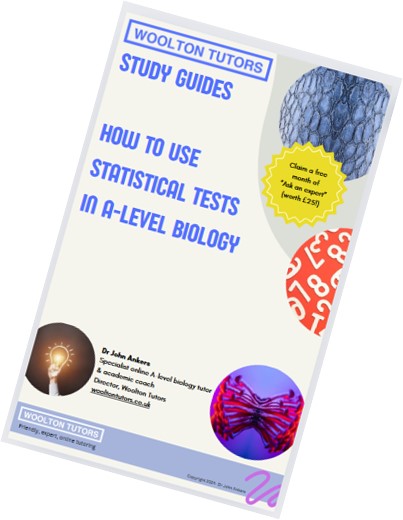
How to use statistical tests in A-level biologyThere’s much more help with statistical tests, p-values, significance etc. (and model answers to statistics exam questions) in our eBook “How to use statistical tests in A-level biology”, available here


If you’d like to work through some A-level biology statistics questions, from exam boards like AQA, please get in touch with me at Woolton Tutors, and we can set up some online A-level biology tutoring sessions. Alternatively, AQA students might be interested in my weekly A-level biology masterclass sessions for practice on exam technique.

Best wishes,

John

Dr John Ankers

Specialist online A-level biology tutor and academic wellbeing coach

https://wooltontutors.co.uk

How to study A-level biology as a private candidate

Many students choose to study A-level biology as a private candidate, enjoying the flexibility of home education/ home-schooling or online education. I have helped several students find their way with the practicalities involved, like choosing an exam board and an exam centre. I have also tutored several A-level biology candidates through all or part of their course. I would like to share some of this advice with you:

How to choose an A-level biology exam board

Choosing an A-level biology course (linked with an exam board) is the first step to sitting A-level biology as a private candidate. I’ve listed some popular choices below, which are respected by universities and colleges. There are differences in their course structure and the types of questions that feature on their exams.

Each of these options involves a mixture of fact learning and recall (often referred to as Assessment Objective 1), applied knowledge (AO2) and evaluating data (AO3). They also involve practical experiments, which, while not compulsory, often help with university applications – see below. Each exam board has a “specification” document which introduces their course in more detail.

AQA A-level biology

AQA is the most popular choice for A-level biology in schools in the UK, and is perhaps also (slightly!) easier than others in terms of the exam content. However, it features a 25-mark essay question on paper 3 which some students may find challenging.

Specification document for AQA A-level biology.

Entry fees for AQA A-level biology.

There are 3 exam papers in AQA A-level biology (each 2 hours long) and  12 practical experiments (see below)

Edexcel Salters-Nuffield A-level Biology

Edexcel uses similar content to AQA, but with greater depth in certain areas. The exams are often more challenging, but reward students able to apply their knowledge and “think like a scientist”. Edexcel is often chosen for students intending to study medicine or related disciples at university because of the (slightly) greater emphasis on medical topics.

Specification document for Edexcel Salters A-level biology.

Entry fee information for Edexcel Salters A-level biology.

There are also 3 exam papers in AQA A-level biology (each 2 hours long) and  12 practical experiments (see below).

 OCR A

Similar to Edexcel, OCR A is another course aimed slightly more towards thinking like a scientist, data interpretation and experimental design (AO2/ AO3). The specification for OCR was recently updated to include more up-to-date case studies.

Specification document for OCR A A-level biology

Entry fees for OCR A A-level biology

There are 3 exam papers in AQA A-level biology (each between 1.5 and 2.25 hours long) and  12 practical experiments (see below)

These are the most popular choices of course providers, but there are several other A-level biology exam boards for private candidates – including Eduqas, OCR B and Edexcel B. Please do get in touch to discuss the pros and cons of these.

Studying International A-level biology as a private candidate

Candidates outside the UK have the choice of several international A-levels. These are slightly different, but broadly equivalent in terms of UCAS and respected by universities. Please get in touch to discuss these options – or take a look at my case study on studying A-level biology in Dubai, as much of the advice applies in other parts of the world.

Choosing an exam centre for A-level biology as a private candidate

There are no options to take the A-level biology exams online… yet. The AQA is trialling a number of digital exams as an option for the future. Instead, you will need to find a local centre to sit your A-level biology exams. The Joint council for qualifications (representing all the exam boards above) has a list of approved centres – take a look to see if there is one local to you. https://www.jcq.org.uk/private-candidates/

What about practical experiments when studying as a private candidate?

School students have the opportunity to perform 12 practical experiments (see the list below) as part of their A-level biology course, towards meeting a set of standards for “thinking like scientists”. These are known as the Common Practical Assessment Criteria (CPAC) – the AQA website (for example) has information on CPAC. Completing these experiments gives you a “practical endorsement” – this does not affect your grade either way, but will appear as a tick box on your UCAS application. Some university courses look favourably or even require students to have their practical endorsement.

If you’re studying A-level biology as a private candidate, one option is to book a space at a private laboratory centre to perform the experiments and gain their practical endorsements. These can be googled, but I’m happy to discuss the options if you want to get in touch. Whichever you choose, make sure they are approved by the JCQ.

For interest, here are the 12 practical experiments:

Practical 1 – Investigation into the effect of a named variable on the rate of an enzyme-controlled reaction.

Practical 2 – Preparation of garlic root meristems to investigate stages of mitosis and calculating the mitotic index.

Practical 3 – Production of a dilution series of a solute to produce a calibration curve with which to identify the water potential of plant tissue.

Practical 4 – The effect of a named variable on the permeability of cell surface membrane.

Practical 5 – Dissection of a mammalian heart.

Practical 6 – Microbiological techniques and investigation into the effect of antimicrobials.

Practical 7 – An investigation of the pigments present in leaves.

Practical 8 – Investigation into the effect of a named factor on the rate of dehydrogenase activity in extracts of chloroplasts: the effect of ammonium hydroxide on the time taken for chloroplasts to decolourise DCPIP.

Practical 9 – An investigation of the effect of temperature on respiration in yeast.

Practical 10 – Using choice chambers to investigate responses in invertebrates to light/dark or humid/dry conditions.

Practical 11 – Use a colorimetric technique to produce a calibration curve with which to identify the concentration of glucose in an unknown ‘urine’ sample.

Practical 12 – Investigation into the effect of a named environmental factor on the distribution of a given species.

Planning your studies and getting help

Once you are enrolled on a course, your first step should be to read your exam board’s specification document. Next, purchase a textbook for your course. The biology can look daunting at first, but there is plenty of help out there.

Be wary of package courses offered on flashy websites and ask yourself: who is delivering the course? how much experience do they have? Can I meet them before I commit? Elsewhere, Student room and even Reddit have dedicated groups for A-level biology students for you to share your experience and ask for advice.

You can also consider one-to-one tutoring to support your A-level biology. I have spent over 10 years taking students through A-level biology exams on all the exam boards mentioned above. I have also helped several students studying A-level biology as a private candidate. I have written blog posts and study guides on A-level biology.

I can provide online one-to-one tutoring for all or part of your A-level biology course, as well as a regular exam technique masterclass. If this interests you, please do get in touch.

I wish you the best of luck!

John

Dr John Ankers
Director, Woolton Tutors
Specialist in online A-level biology tutoring

How to answer A-level Biology essay questions

The Synoptic essay questions on paper 3 of the AQA A-level biology course carry 25 marks, so doing well can make a big difference to your overall grade. The essay encourages you to think across different topics (some call this “synoptic” or “holistic” thinking). This is also valuable for other areas of the exams, particularly the application questions.

Here are a few tips for tackling your A-level biology essay: (As an example, let’s use the title “The importance of movement in cells and tissues”)

  1. Think broadly…

Essay titles are deliberately vague to give you the chance to show your knowledge in a variety of topics. To help you to choose what’s most relevant, look out for subjective words like “movement” and “cells”. Think of the possible alternatives. “Cells”, for example, hints that you could discuss plants, animals, single-celled organisms etc. in your essay. “Movement” could mean short distances (across a membrane) or much further (circulation or mass flow) or even the whole tissue moving (phototropism). Continue reading “How to answer A-level Biology essay questions”

How to answer A-level biology describe and explain questions

The wording of A-level biology describe and explain questions is  important.  Often when people lose marks in exams, it’s not due to being completely wrong, but slightly wrong – the answer might make perfect sense, but miss the point of the question. Very frustrating!

I’ve written about how to answer A-level biology evaluate questions, and application questions, (and how to choose a statistical test), but what about Describe and explain questions? What’s the difference? What does each question want from you?

Answering A level biology describe questions

“Describe” questions want to know what is happening in front of you – perhaps in a graph, a scientific diagram or a picture. You need to describe what you can see!

Describe and explain questions in A-level biology
A typical A-level Biology graph. Describe – What can you see? Explain – Why does it look like this?

Imagine the examiner doesn’t know any biology and can’t see the paper – your job is to tell them what’s going on. What is the line in the graph doing? What is the plant in the picture above doing in response to sunlight?

The line may show a relationship between two variables – look for their names on the axes of a graph. Can you see a correlation between temperature and enzyme activity? Or, for the plant picture, the bend of a plant and the light levels around it?

Steer clear of using “it” in your descriptions – use scientific names instead. “The gradient of the line is…” or “the line representing enzyme activity flattens after…

Keep an eye on the number of marks the question is worth – these will tell you how many details you need to mention.

Answering A level biology explain questions

Explain questions want to know why something is happening. You may still have a graph in front of you, but why does it look like that?

Focus on scientific explanation – what is going on “behind the scenes”? If the graph is of enzyme activity, we might talk about how the enzyme meets the substrate and the effect of temperature on how often this happens – explaining why the graph points upwards.

Use clear language here, too. Instead of “it” use the correct names for whatever you are writing about. Clear language doesn’t have to involve lots of scientific words. The idea is that your points logically follow each other. This happens, then this happens… so in the graph this happens.

Use the word “because” in your answer – it’s a good way to focus yourself on the explanation rather than the description.

Answering A level biology describe and explain questions

Some exam questions ask you to both “describe and explain”. Here you can be methodical – look at the number of marks for the question and divide it in half. This is the number of points you need to mention, including a description and explanation for each.

Remember for each pair of marks – first describeWhat does this look like?” then explainWhy does it look like that?”

Answering A level biology Suggest questions

Some questions may ask you to “suggest an explanation” for a graph or an event in the text. This is slightly different to an “explain” question as it gives you a little more freedom.

There may be multiple reasons why something behaves as it does, or why a line flattens on a graph. Your job here is to pick a theory than makes sense, then argue how and why it explains what’s going on. The mark scheme will likely have lots of flexibility to allow for whichever explanation you choose.

If you have any questions about the difference between suggest, describe and explain questions just get in touch.

Good luck!

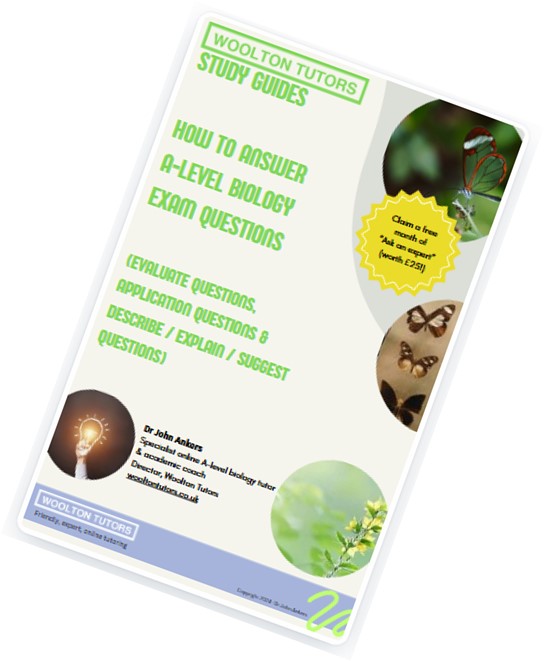
You can find an expanded version this guide, with added bits including model answers to real describe and explain exam questions, in our shiny eBook “How to answer A-level Biology exam questions“. A purchase from our shop gives you a month’s free subscription to “ask an expert” – very useful for some exam practice 🙂


If you’d like to work through some A-level biology describe and explain questions, from exam boards like AQA, please get in touch with me at Woolton Tutors, and we can set up some online A-level biology tutoring sessions. AQA students might be interested in my weekly A-level biology masterclass sessions for practice on exam technique.

Best wishes,

John

Dr John Ankers

Specialist online A-level biology tutor and academic wellbeing coach

https://wooltontutors.co.uk

How to answer A-level biology application questions

A lot of our tutees ask how to answer A-level biology application questions. Application questions (AKA “applied knowledge” questions or assessment objective 2, AO2 questions) challenge you to apply your knowledge in an unfamiliar setting. Essentially, they are biological puzzles, and you have all the information you need to solve them – the real challenge is working out how and where to start.

Here are a few tips to guide you through:

  1. Ask yourself – what topic is this?

Look for key words and phrases that give you clues to which topic area (or areas) the question relates to. There may be a lot of information in the opening part of the question here that you’ve not seen before – that’s ok! It’s designed that way. If there’s a strangely named chemical described as an enzyme, everything you know about enzymes and proteins might be useful. Do we have an unfamiliar gene? Great – now everything you know about transcription, translation, epigenetics and even genetic engineering could be relevant.

It’s best to start with a clear idea of the context of the question.

Continue reading “How to answer A-level biology application questions”

How to answer A-level biology evaluate questions

One of the most popular requests from online A-level Biology students is “How do I answer A-level biology evaluate questions?” (AKA assessment objective 3 (AO3) questions)

Usually, these questions involve scientific data and a conclusion made by a student, journalist or politician. The idea is to discuss their conclusions and decide how much you agree.

Here are a few tips to try:

1. Don’t be afraid to agree AND disagree

Evaluate questions are usually looking for a balance of your opinions. You probably won’t agree completely, or disagree completely with a conclusion and that’s fine. The good news is there are marks for providing evidence for and against.

2. Look for “sweeping” statements

Usually “evaluate” questions are testing your ability to spot where the “story” in the science has been misinterpreted. Often the conclusion over-reaches – maybe it says a drug “cures lung disease” when the data only shows an effect on cells in dish, or in rabbits rather than humans. Look for places where the conclusion and the data are mismatched. Continue reading “How to answer A-level biology evaluate questions”

Five common PhD viva questions (and how to answer them)

I thought my viva would be a walk in the park. I’d proofread my thesis so many times – given chapters to unfortunate colleagues, polished the thing until it gleamed. Surely the viva was just a formality? What PhD viva questions could they possibly ask? Then I opened the door and saw my examiners, glasses perched on noses, with the copies of my thesis bristling around the edges with post-it notes.

Your PhD viva voce or defence is the culmination of a lot of hard work. Years of trial and improvement, highs and lows, dead ends, changes in direction. It’s a story of you and your choices as much as it is a piece of research. You owe it to yourself to be prepared. One final hurdle. Then you can write “Dr” on your Tesco Clubcard. (And if you’d like some one-to-one help preparing for your viva, please see here.)

During your viva, your examiners are trying to establish three things –

  • That you did the work (and wrote the thesis) yourself.
  • That you can defend (and argue) your choices and conclusions.
  • That you are (trying to be) free from bias.

A viva is like a job interview… after you’ve done the job. The overriding question is “is this person worthy of joining academia”?

Here are five PhD viva questions your examiners will ask, and how to answer them:

1. Why did you decide to do *this part of your research* in this way? Continue reading “Five common PhD viva questions (and how to answer them)”

A-level biology summer school – get a head start on next year

Our online A-level biology summer school sessions are here to help.

The sessions are designed to reassure and prepare – whether you’re making the transition from GCSE to A-levels (and we have a blog that may help), or heading towards your exam year and more detailed topics in Year 13.

Your choice of online A-level biology summer sessions

Summer one-to-one tutoring
Friendly, one-to-one A-level biology tutoring sessions are available during the summer holidays. Click to find out more about tutoring with John.

Summer masterclasses
In this year’s summer masterclass sessions for small groups (£35 per hour session) we’re covering four important areas on four evenings (5:30-6:30pm) in August (see below for timetable).

Email John@wooltontutors.co.uk for a chat about your needs and to book your place.

Mon 04/08/25 Genes and protein synthesis (and exam practice)
Wed 13/08/25 Meiosis and mitosis (and exam practice)
Wed 20/08/25 The immune response (and exam practice)
Wed 27/08/25 Biological molecules (and exam practice)

The sessions are designed around “core” topics, combined with exam technique for application and evaluate questions, so as to be useful for AQA, Edexcel (Salters) and OCR students – where appropriate I will indicate where the exam boards differ in what you need to know and prepare for. The aim is to give you more confidence in your biology studies 🙂

We are also taking booking for the term-time A-level biology masterclass, starting October 2025.

Useful for A-level Biology students about to start Y12 (AS):
  • Help getting ready for A-level biology, with a head start on biological molecules, cells, DNA and other topics you’ll meet in the first year of A-level biology.
  • Gently make the transition from GCSE to A-level, seeing where the course builds on what you already know.
  • Get answers to any questions you might have about the course, or the science itself.
  • Top up your maths skills ready for the “maths for biologists” aspect of the A-level course.
  • Explore the different types of questions that come up in mocks, class tests and the A-level exams themselves.
  • Put A-level biology topics into context, reflecting on the latest research, career ideas, and university prospects.
Useful for A-level biology students entering Year 13 (A2):
  • Recap your Year 12/ AS biology learning, with “troubleshooting” on any topics you find challenging.
  • Work on areas for improvement following mock exams or class test results.
  • Get a head start on Year 13 topics that delve deeper into DNA, genetics and the nervous system.
  • Focussing on the assessment outcomes (AO) of the major exam boards.
  • Work on specific aspects of the exam, such as “evaluate” questions, “application” questions and exam technique.
  • Boost your confidence ahead of the new term.

Please get in touch with me (John@wooltontutors.co.uk) for a chat about our A-level biology summer school and we’ll take it from there.

All the best,

John
John@wooltontutors.co.uk

Dr John Ankers is a specialist online A-level biology tutor, coach and writer

https://wooltontutors.co.uk

A-level biology grade boundaries 2025 and exam dates

It’s often difficult to find the A-level biology grade boundaries and exam dates all in one place, so I hope this is helpful. 🙂

Grade boundaries for the 2025 A-level biology exams

AQA A-level biology grade boundaries:
Based on 2024 AQA A-level biology results
A* 74% (192/260 marks), 63%  A (165/260), 54% B (140/260), 44% C (115/260) (scores rounded to nearest mark)
2023 grade boundaries
A* 69% (180/260 marks), 59%  A (153/260), 48% B (125/260), 38% C (98/260)

Edexcel (Salters Nuffield) A-level biology grade boundaries:
Based on 2024 Edexcel A-level biology results
A* 66% (199/300 marks), 57%  A (171/300), 48% B (144/300), 39% C (117/300) (scores rounded to nearest mark)
2023 results
A* 74% (222/300 marks), 64%  A (192/300), 54% B (162/300), 44% C (132/300)

OCR A-level biology grade boundaries:
Based on 2024 OCR A-level biology results
A* 68% (187/270 marks), 57%  A (160/270), 48% B (136/270), 39% C (112/270) (scores rounded to nearest mark)
2023 results
A* 68% (183/270 marks), 57%  A (155/270), 48% B (130/270), 39% C (106/270)

Exam dates for the 2025 A-level biology exams

AQA A-level biology (based on this page)
Paper 1 – 5th June pm (2 hours)
Paper 2 – 13th June am (2 hours)
Paper 3 – 18th June am (2 hours)

Edexcel Biology A (Salters Nuffield) (Based on this page)
Paper 1 – 5th June pm (2 hours)
Paper 2 – 13th June am (2 hours)
Paper 3 – 18th June am (2 hours)

OCR A (Based on this page)
Paper 1 – 5th June pm (2 hours 15 min)
Paper 2 – 13th June am (2 hours 15 min)
Paper 3 – 18th June am (1 hour 30 min)

Good luck! Hope these help 🙂

Best wishes,

John

Dr John Ankers

Specialist online A-level biology tutor and academic wellbeing coach

https://wooltontutors.co.uk